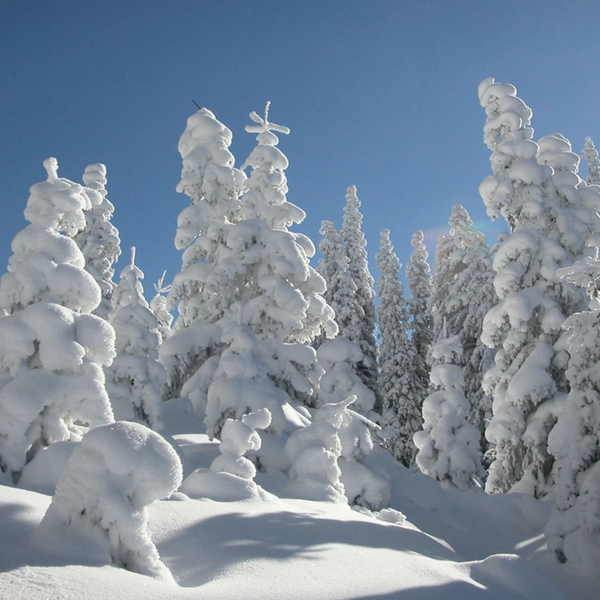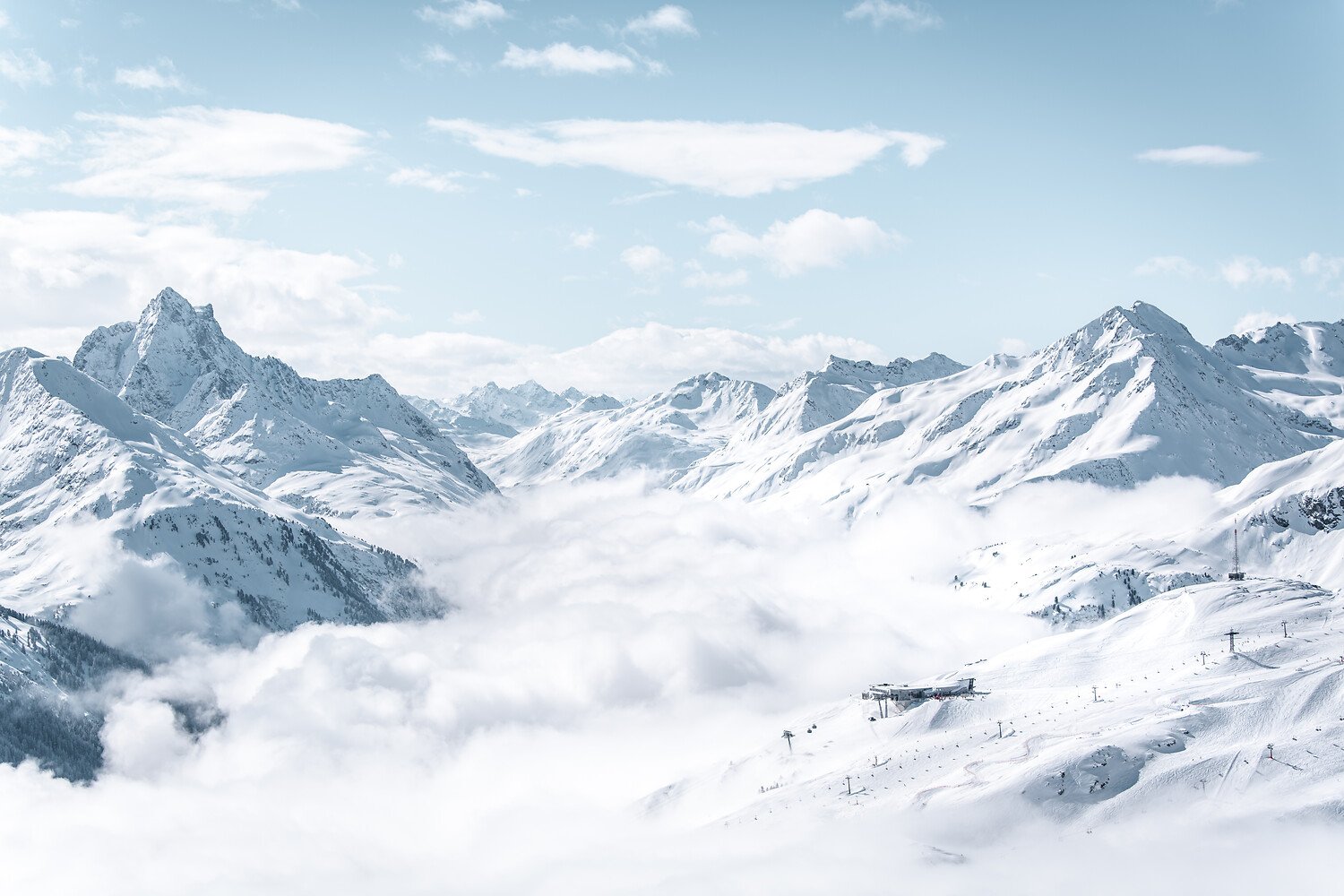
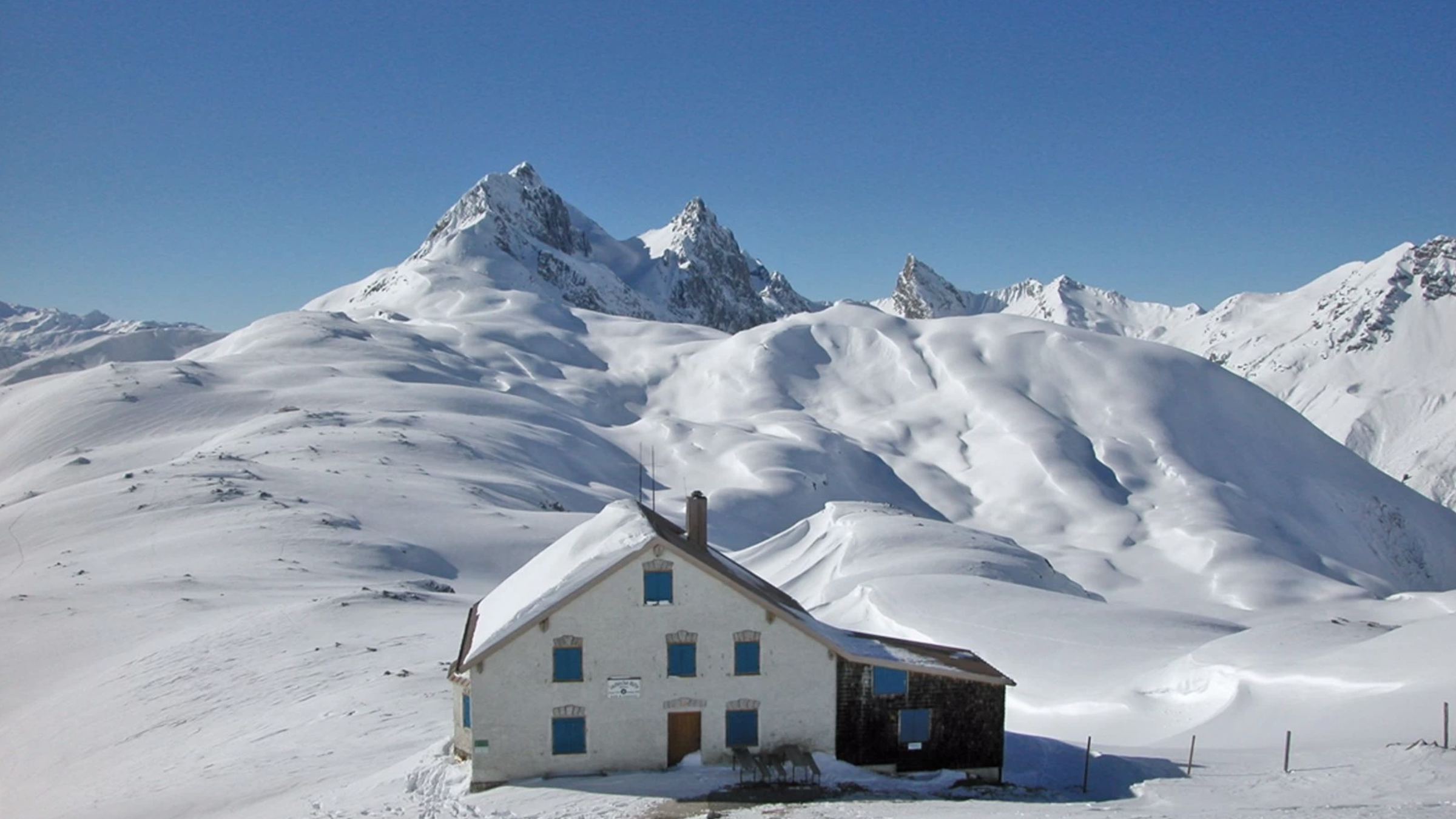
Snow is fluffy; snow is heavy. Loose, fluffy powder snow – the sort that makes you want to whoop with delight – has a density of around 50 to 80 kg/m³; average fresh snow around 100 kg/m³; and a snow cover that has been lying for some time around 250 to 300 kg/m³. These figures also apply to snow loads on houses and hay sheds. It is easy to calculate the snow load on a roof: approximately 25 to 30 kg/m² per 10 cm of depth. But what is it that makes the Arlberg in particular so snowy? The moist air masses flowing in from the Atlantic or the North Sea are forced to rise by the Alps. In the windward area, on the western side of the Arlberg in Langen, around 9 metres of snow falls in total over the course of a year; in St. Anton, on the leeward side of the Arlberg Pass, the figure is still almost 5 metres. Between the Ulmerhütte and the Valluga, interpolated figures show 12 metres of fresh snow per year. A real treat for powder enthusiasts between December and April.
From Arlberg Magazine: Snow – a familiar yet mysterious phenomenon – explained using the Arlberg as an example. By Karl Gabl, meteorological expert
Billions of snowflakes blanket the Arlberg in a white carpet of snow year after year. ‘Winter fairy tales’, ‘powder euphoria’ and ‘white bliss’ are typical ways of describing the enormous abundance of snow on the Arlberg. It is a magnificent sight and a dreamlike experience to ski down the pristine powder slopes into the valley.
Whilst enjoying the thrill of gliding down slopes covered in deep powder snow, one rarely thinks about the wonder of snow and the physics behind it. It is a widely held belief that a snowflake is a hexagonal star (dendrite), because snow crystals are usually depicted in this simplified form. As early as around 1600, the renowned naturalist Johannes Kepler described the hexagonal structure of snow crystals in his work *De nive sexangula*. His observations were later scientifically corroborated by the crystal lattice structure of ice. But dendrites are by no means the whole story. There is a vast array of very different snow crystals. Depending on the temperature and the moisture content in the air, a wide variety of shapes form. The rule is: the more humid the air in the cloud is – where saturation relative to an ice surface can be as high as 160 per cent – the more complex the shape of the snow crystal can be. In addition, the appearance of snow crystals also depends on the speed at which they grow.
The highly branched snow crystals form relatively quickly at temperatures between -13 °C and -16 °C; the thin plates, needles and hollow columns (prisms) at temperatures between 0 °C and -8 °C; thick plates are formed at temperatures of around -10 °C to -20 °C; and the rarities amongst snow crystals – solid columns and, occasionally, hollow prisms – can be found down to -39 °C.
Dumbbells are also formed from a combination of plates and prisms. Spherical graupel grains indicate the deposition of water vapour, which was present in abundance in the air and which, much like the accumulation of snow around a summit cross, settled around the original dendrite. But even the ice needles, barely visible to the naked eye, which make the sun glisten as they reflect its light, are snow crystals. If large snowflakes, with their extensive surface area, are not buffeted up and down by turbulent winds, they drift slowly to the ground at a speed of approximately 4 km/h due to their high air resistance. By way of comparison: the ‘slenderer’ medium-sized raindrops reach speeds of around 20 km/h; hailstones with a diameter of 2 centimetres fall at 70 km/h; very large hailstones can even reach speeds of 150 km/h.
The average diameter of snowflakes is 0.5 centimetres. According to the Guinness Book of Records, the largest cluster of small crystals – the giant snowflake – has a diameter of 38 cm. As they fall onto water, snowflakes produce a shrill, high-pitched sound with a frequency between 50 and 200 kilohertz, which cannot, however, be heard by the human ear.
Skiers enjoy the freshly fallen, mostly star-shaped crystals the most, as these are also the most common. As a blanket of snow builds up, the snow crystals do not retain their shape. Even as they fall, they are mechanically shattered and scattered by the wind. This results in the formation, away from the groomed slopes, of an unwelcome layer of wind-hardened snow, which demands the utmost skill from expert skiers. The greatest danger to skiers, apart from avalanches triggered by enormous amounts of fresh snow, lies beneath the snowpack: floating snow, also known as deep hoar. This forms within a few days when the snowpack is thin and air temperatures are very low. The crystals formed by the sharp temperature gradient within the snowpack become larger than the snow that has already settled. Due to their shape, the angular and cup-shaped crystals of floating snow bond significantly less effectively with one another. The strength of the snow is reduced, and the snowpack becomes destabilised. The avalanche risk is often further increased by a wind-hardened crust or by snow drifts.
Dotted with millions of frost crystals, the snowpack glitters in the sunlight. Surface frost crystals grow several centimetres in height. Particularly large frost crystals can be found after a prolonged spell of fine weather whilst hiking on the Ferwall between the Maroibach stream and the Ferwall rest house. The surface frost crystals glisten like diamonds in the sunlight beside the cross-country ski trail.